


Every brokerage putting AI into its workflows is asking the same question: does this close gaps, or open new ones?
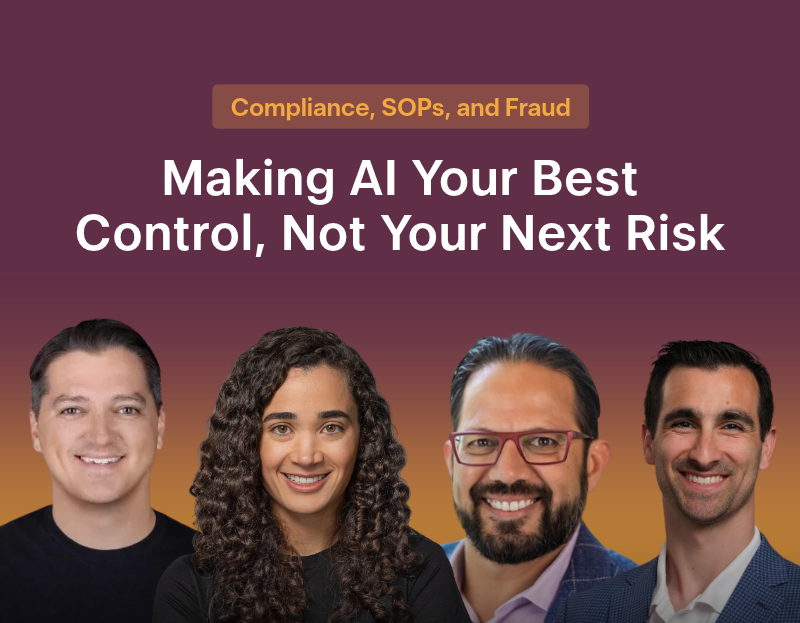
At McLeod Software's 2026 User Conference, Chain took that question on directly. Kevin Coomes, Chain's Chief Revenue Officer, moderated a panel with Annalise Sandhu, Chain's Co-Founder & CEO, Omar Singh, President of Surge Transportation and a Chain customer, and Luke Falasca, Enterprise AE at Highway.
Kevin framed it from the start:
"When you remove your people from the equation and you start automating these tasks, you have to be very, very clear on what you're automating, and why."
The short version of where the panel landed: AI isn't a magic fraud detector. It's an enforcement layer. It checks the same things your best rep would check, on every load, every time.
AI enforces the SOPs you already have
Annalise was clear about what AI does and doesn't do in fraud prevention.
"AI is not gonna have some type of advanced algorithm that's gonna detect fraud. Those signals are already gonna be there... AI is really just gonna help you to enforce any SOPs that you have."
Annalise Sandhu, Co-Founder & CEO, Chain
The signals live in your TMS, in your compliance tools, and in Chain. The problem is that nobody can watch all of them on every load. At Chain, AI acts as another set of eyes that never leaves the load. In practice, that looks like:
- Detecting when someone downloads the mobile app and tries to start fraudulent tracking, then pinging the carrier sales rep on the load until someone looks at it
- Confirming the truck and trailer match what's on the load
- Catching the checks that are written into your SOPs but get done 90 times out of 100, because reps have too much on their plate
It also doesn't clock out. 46% of Chain's Autopilot activity happens after hours, when most brokerage desks are empty.
Kevin added the other half of it. AI is good at spotting what looks off across carriers, lanes, profiles, and tracking data. Calling something fraud with certainty is a harder problem. So Chain's job when something looks wrong is to get a person on it immediately, by text, email, Teams, or Slack, before it gets worse.
The step four problem
Omar has been in freight for about 30 years. He got his CDL in 1994, ran a trucking company, and started Surge in 2016. In his experience, a stolen load or a missed pickup is rarely one person's mistake.
"It's usually what I call a catastrophic failure of all departments... It never makes sense. You almost wanna cry. Every single department didn't do step four."
Omar Singh, President, Surge Transportation
He shared one from a few months before the panel, before Surge brought on Chain. A carrier that had run around 25 loads for them was going out of business. On the way out, they spoofed their tracking and stole a string of loads across the market. Two were Omar's. The missed step was ELD tracking. The carrier had turned theirs off, but they had history, so the team made an exception. ELD is now non-negotiable at Surge, no matter how many loads a carrier has run.
Annalise said Chain sees the same pattern when it investigates stolen loads. Most of the time, a signal was there. On that one load, every person missed it. That's exactly the gap Omar has been using Chain to close for the last six months.
"Relying on you guys to make sure it just can't get missed, it's really been a tremendously good user experience."
Omar Singh, President, Surge Transportation
Fraud moves fast, so your tools have to
Annalise pointed out that brokers aren't the only ones with AI.
"The fraudsters also have AI tools that they're using... Attack vectors today are not gonna be the same as they are six months from now."
Annalise Sandhu, Co-Founder & CEO, Chain
That's why Chain keeps evolving the signals it watches, combines its own data with tools like Highway, and treats every bad actor it finds as a lead. When Chain catches one on the platform, the team traces who else they're tied to, what they did before, and who they were working with. That data gets more useful over time.
Luke added where most of today's fraud starts: nearly 75% of what Highway has seen in the last year traces back to a breach in communication, usually a legitimate carrier's email getting compromised. The fix is keeping load details and rate cons inside secure channels, even when a carrier says the link "isn't working."
Hard no's, soft no's, and where people stay in the loop
Annalise's advice for deciding what to automate is to start with your absolute no's.
- Hard no's get automated out of the booking process entirely. Your team never spends time on those carriers.
- Soft no's keep a person in the loop until you've nailed down the criteria and have a deep enough network to cover the lane consistently.
"You don't have to automate 100% of it to get the ROI from software."
Annalise Sandhu, Co-Founder & CEO, Chain
For most brokerages, she recommends that a person still says yes to the carrier. Chain does the work up front: these carriers are in range on the bid, these match your vetting criteria. Then someone reviews it and clicks approve. Some customers fully autobook, but that assumes your process is 100% right and the AI has all the data, which isn't always true. There's also the call where a carrier just sounds off, and AI won't catch that today. Her advice: check back in two years.
Omar's team runs exactly this way. Three people handle exceptions, using the full picture: a carrier with no history in Texas might still get a load there if the rate makes the trip worth it, and a carrier with a few mismatches might get approved if their pickup history and time in business hold up. He'd rather see every flag and make the call himself, and he sees carrier scoring as the next step to take some of those calls off management's plate.
Scaling without losing control
Freight brokerages have always scaled by adding people. Omar has seen where that breaks.
Surge once had around 300 people and now runs with about 30. At that size, he said, he couldn't enforce SOPs or keep decision-making consistent, and mistakes piled up. Now he hires one or two people at a time and spends two or three months with each of them.
"There are tools now that kind of make me go, I could probably do it better this time around. And you guys are one of them."
Omar Singh, President, Surge Transportation
That's the shift Chain is built around. When the SOP is built into the system, the fifteenth rep follows it the same way the first one does.
The audit trail is the underrated benefit
Annalise pointed out something that's easy to overlook: AI keeps a record. Every carrier rejected, every carrier let through, and the reason behind each decision gets logged, so you can point back to it for training, for leadership, or in a court of law.
Luke noted that matters more in a post-Montgomery world, where a nuclear verdict can cost more than a stolen load. When something goes wrong, the question is whether your SOP was followed and whether you can prove it.
Kevin asked the room who thought their brokers did a great job documenting everything they do. No hands went up.
Who's accountable when AI gets it wrong
Annalise didn't leave room for debate.
"If you're working with a vendor that does not hold themselves accountable if something goes wrong... you're working with the wrong vendor."
Annalise Sandhu, Co-Founder & CEO, Chain
Whether it's a bad actor on the platform, an outage, or the AI doing something it shouldn't, Chain treats it as a product problem to fix. Edge cases are how the product gets better.
Omar was just as direct from the broker side. The broker loses the customer and pays the claim, so he vets vendors hard. He's tried AI for appointment scheduling and AI answering phones, and neither fit how Surge works. What he looks for is a vendor that assigns a real team member and keeps building with him. His team meets with Chain every two weeks, and there's a new project on the list each time.
What to audit this week
Kevin closed by asking each panelist what brokers should go back and shore up.
- Annalise: Start with your SOPs. Do you have them? Are they detailed enough, and do they match how fraud works today? Then check whether your team follows them, and decide how to enforce them, whether that's AI, software, rule changes, or training.
- Omar: Know your driver, ELDs, and VINs. Knowing the truck is the right truck and the driver is who they say they are, on every load, is what lets him sleep at night.
- Luke: Check insurance down to the VIN of the truck moving your freight, and make sure it's in your audit log.
Why it matters
AI will make brokerages faster. Whether it makes them safer depends on what you tell it to enforce.
"You can introduce all the technology in the world... if you don't have your processes down, if you don't have your data integrated, if you don't have your partners working together, it's not gonna work. AI is not a silver bullet."
Kevin Coomes, Chief Revenue Officer, Chain
That's what we mean by AI that moves freight. Systems execute your SOPs on every load, people handle the exceptions, and you scale freight without scaling the manual work behind it.
Watch the full session here ↓
Want to see what it looks like when your SOPs run on every load? See Chain in action.


